It's getting close to springtime in Minnesota and with the heavier than usual snowfall that means lot's of moisture. This year will probably be different than last year where the ground was frozen solid and a lot of moisture was entering foundations through cracks that extended above grade level.
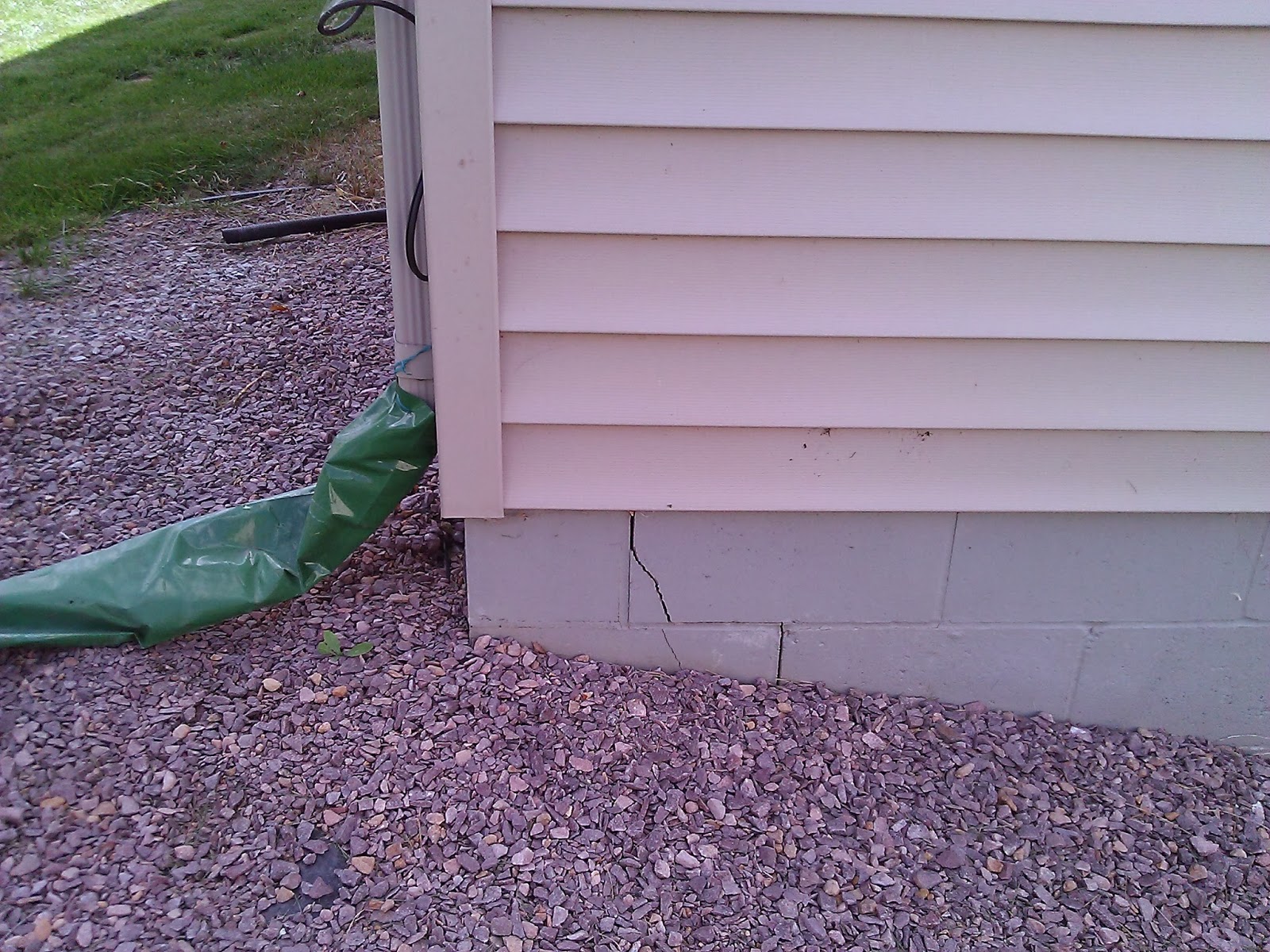
This block wall foundation is a great example of several mistakes done by the owner hoping to keep water from entering his foundation and one that was a headache for the homeowner last year during the spring thaw.
The first mistake is having the downspout end just a few inches from the ground where it is more susceptible to freezing and clogging up. We always recommend about 18" off the ground to get the proper slope. In addition we always recommend solid metal or plastic extensions, 10' if possible. With a good slope and the longer length it will help get that water away from the problem areas. This extension (the green piece) is also pointed towards the left when it should be pointed at us which would make it easier to hit the slope of the yard heading towards the right. With this set up the water is getting dumped into the pea gravel (towards the left) but then heading to the right. Along the route is this nice stair step crack that most likely goes from floor to ceiling in the basement
This basement has a working drain tile system but when there's rain, some of the water does work it's way into the system but the crack we see on the outside is also visible on the inside and taking the path of least resistance, it dumps out above the floor, skipping the drain tile system.
Showing posts with label exterior waterproofing. Show all posts
Thursday, March 6, 2014
Monday, March 25, 2013
Great article from the Billings Gazette about the bentonite industry. While this material has hundreds of uses, it's properties make it perfect for exterior foundation waterproofing.
May 21, 2012 12:00 am • By MARTIN KIDSTON mkidston@billingsgazette.com
GREYBULL, Wyo. — Applications to mine “the clay of 1,000 uses” are pouring into the Bureau of Land Management as companies look to capitalize on the bentonite boom and keep pace with the nation’s rebounding economy.From mines at Frannie to Bearcreek, companies have ramped up production, racing to extract a commodity that was deposited millions of years ago as volcanic ash and chemically reworked in a shallow, inland seaway.
At M-I Swaco’s mine east of Greybull, BLM geologist Gretchen Hurley holds a lump of bentonite in her hand. With the consistency of Play-Doh, the damp product is easily shaped, rolled and squeezed.
“I think the new applications are a result of companies trying to get ahead of the permitting curve, because it takes a while to permit one of these mines,” Hurley said. “If we can get them approved for a 500-acre mine, that’ll keep them supplied in bentonite for 10 to 30 years.”
Bentonite has the ability to swell to 16 times its original size and absorb 10 times its weight in water. It’s used in cat litter and beauty supplies and as a binding agent in animal feed. It’s also used in foundry work and in drilling, including in the Bakken field of North Dakota.
The clay’s industrial uses tie it directly to the nation’s energy and auto industries. With the economy on the mend, the bentonite industry has followed suit, restoring jobs lost in 2008 while creating an increase in mining applications across the region.
At the American Colloid plant east of Lovell, plant manager Steve Wilkerson said that at height of the recession, around 42 employees lost their jobs. Around 30 of those jobs have been restored and production has increased, surpassing pre-recession figures.
“Before the recession we were running at around 650,000 to 700,000 tons a year,” Wilkerson said. “In 2008, we dropped off to around 280,000 tons. At the present moment, the way things are going right now, we should be back at around 750,000 to 780,000 tons.”
Bentonite means business
The life of a bentonite mine depends on market conditions, and it’s Lyndon Bucher’s job at American Colloid to ensure that a steady flow of clay is available to keep pace with customer demands, including the oil industry, General Motors and Caterpillar.
Bucher, who works in American Colloid’s permitting and reclamation department, said that like all mining operations, clay is subject to booms and busts. Business lately has been up.
“Bentonite is considered an industrial mineral, and so it goes into a number of different products,” Bucher said. “You could say we’re something of a bellwether for the national economy. For the most part, as the economy goes, so goes the bentonite industry.”
Wyoming’s annual bentonite production has risen from 1,400 tons in 1927 to more than 4.5 million tons. Five companies are engaged in 19 active mining plans across several counties in Montana and Wyoming, according to the BLM.
“I’m supposed to maintain at least five years of permitted reserves in every grade of bentonite,” Bucher said. “We’ll do the exploration drilling to locate and grade the product. Once the exploration is done, we know where we need to permit.”
This arid region of the basin, which extends down the western front of the Pryor and Bighorn mountains in Montana and Wyoming, is considered one of the world’s top producers of high-swelling, sodium-type bentonite clay, representing nearly 70 percent of the world's known supply.
According to the Wyoming Mining Association, the industry employs about 605 workers in the Bighorn Basin, including mill operators, mechanics, surveyors, packaging operators and laboratory technicians. For every job provided by the industry, an estimated three additional jobs are created in the community.
In Wyoming, where most of the activity takes place, the industry contributes more than $11.3 million in taxes and royalties. Its annual payroll with benefits comes to roughly $48.3 million, with nearly 70 percent of that paid to employees in the Bighorn Basin.
“Without the bentonite industry, you could fold Big Horn County up and it would go away,” said county Commissioner Keith Grant. “Of our top 10 assessed valuations, four are bentonite companies. The top two are oil and gas, and the railroad is in there, too.”
Remaining reserves
It wasn’t until 1888 that the first commercial shipment of bentonite was made. The clay earned its name from discoveries in Montana’s Fort Benton Formation. It’s been sought after ever since.
Large-scale bentonite mining and processing in this region began near Greybull in the early 1950s. More than 21,000 acres have been mined in the Bighorn Basin to date, according to the BLM.
On the hood of her truck, Hurley lays out a map with the mines designated in red. The bentonite sought by companies lies in a north-south trend along the eastern rim of the basin.
“This whole horizon of gray shale that’s in front of us — we’re looking at a long strike, or a trend, and there are bentonite beds all along that profile,” Hurley said. “It’s a big, huge area.”
Hurley said an inland sea once covered this region while mountain-building volcanoes to the west spewed ash. The ash settled into the sea, where it was chemically worked over time.
Buried by sand, pressurized and compressed, it became the product rolling by the ton into the basin’s plants. There, it’s dried, processed and packaged in powder and granular forms to meet customer needs.
“There are several different beds, and each bed has its own unique properties,” said Jason Schneider, the mining operations manager with American Colloid. “We’re trying to select different beds to meet the demands for the final product.”
Standing at a cross-cut at the Frannie mine on the state line, Schneider notes the striated layers of shale and the bed of bentonite below. Even here in this small pit, no more than an acre in size, the bentonite comes in yellow and blue.
Schneider said each bed of clay is given to a different set of qualities suited for a variety of industrial uses. It’s up to the companies to extract and process the right clay for the job.
“For this location, it’s a lot of drilling mud,” Schneider said. “With the activity in North Dakota, in the Bakken, that increases the demand for drilling mud. Foundry work has been real strong as well — the auto market. Those things are coming back, and when the economy starts to pick up, you see it on this end.”
Estimates vary on how much accessible bentonite remains here in the ground. A 1989 report by the American Institute of Mining Engineers suggests that around 1.1 billion tons have yet to be mined.
A 1980 edition of the U.S. Bureau of Mines, Minerals, Facts and Problems lists bentonite reserves of around 200 million tons. Either way, it’s enough to keep the bentonite industry supplied for years to come.
“If it’s oil and gas drilling, we’ll target a specific clay for that, and if it’s cat litter, we’ll target another clay for that,” Bucher said. “We have many different customers, and we’ll try to meet the market demand by mining in these different areas and getting the right quality of clay into the plant.”

For those looking for exterior bentonite pressure injection for waterproofing you've found the right place. Exterior waterproofing using bentonite was discussed on the Home Improvement Show with Lindus Construction on WCCO Radio Saturday Morning with the experts agreeing that stopping water on the exterior (with bentonite) is the best way to truly waterproof your foundation.
The example presented was a wet basement floor leaking from the seam the floor and wall make. In most cases this is a cold joint with no gasketing meaning that it's two pieces of concrete installed at different times. Once the water pressure outside is high enough it will push water through this area.
Using a waterproofing mix of all-natural bentonite, Great Lakes Waterproofing fills the water-pathways, once the bentonite sets up water cannot pass through it, creating a waterproof barrier. More water pressure just pushes the bentonite tighter against the foundation.
For new construction we can install a bentonite membrane before the concrete is poured. We overlap all the seams and cover everything below grade. Once backfilled this is one of the most durable types of waterproofing known.
Tuesday, November 6, 2012
My Concrete Wall Is Leaking!
This is one of my favorite wet basement photographs, and really backs up the phrase "a photo is worth a thousand words." The photo shows an inside foundation wall with some insulation removed. This wet basement area was leaking a great amount of water on the floor during big rains. The home owner was mad because they had a drain tile system but it was dry most of the time. The photo shows a vertical wall crack and the dark area is water on the foundation and floor and what's left of a tie rod above the black corrugated channel on the floor. With poured walls, tie rods were used to hold forms together when they poured the walls. When the concrete sets, the forms are pulled but the contractor has no choice but to leave these tie rods in the concrete (they normally bust off the protruding tab ends). Made of metal, these tie rods rust when exposed to water, this one is no different leaving a good size hole in the wall and possibly providing a stress point that lead to the vertical crack.

The black corrugated channel is supposed to capture this water and drain it down to an underfloor drain tile system leading to a sump pump and sump pit. This drain tile system has failed here and a few other places in this basement and we see this type of drain tile failure often especially when the water comes out above the floor.
Great Lakes Waterproofing uses all methods of waterproofing, they all have their strong points, but we love to do exterior waterproofing and really seal up the foundation. In most cases, exterior hydroclay waterproofing is the least costly. In this situation we injected all-green bentonite hydroclay along this side of the home, filling in voids and cracks. Once set up water is not able to get through this barrier and after a year and a half of record rain fall this basement is dry again.
For customers wanted to address the crack as well, we offer Fortress Stabilization Carbon Fiber Strips. We would use marine grade epoxy and attach carbon fiber strips to staple up the crack preventing it from future movement.
www.TCWaterproof.com
Monday, October 8, 2012
Voids Around the Foundation
Sometimes it's hard to explain to a home owner that they might have large air cavities next to their foundation, sometimes even running the length of the wall that might be letting in large amounts of water. Over time the ground has settled and leaves voids that fill with water during a hard rain or even when watering the lawn.
With our Great Lakes Waterproofing's Bentonite (Hydroclay) Injection System the idea is to fill these voids in with Bentoseal Bentogrout. This Bentonite Compound will fill the voids, seek out the water pathways and when properly set up, not let further water invade this space, true waterproofing, stopping water on the outside before it has a chance to enter the home.
It's not often we get a chance to show a photo of these voids but these clearly show that once the driveway was cut away it exposed these air cavities. These cavities can hold hundreds of gallons of water and once the water finds an opening it will drain onto your floor, this can last days after the rain stops.
The water can enter the blocks or poured wall at any point, Some waterproofers might recommend digging around the foundation, maybe two or three feet and laying a rubber membrane bolted to the foundation, this is why membranes that only go a few feet down are useless, the point of entry might be further down
the wall, we've poked through membranes and found voids further down. Yes, we've done work on homes with rubber membranes. For exterior waterproofing there's only one company that pulls together over 34 years of business experience.
With our Great Lakes Waterproofing's Bentonite (Hydroclay) Injection System the idea is to fill these voids in with Bentoseal Bentogrout. This Bentonite Compound will fill the voids, seek out the water pathways and when properly set up, not let further water invade this space, true waterproofing, stopping water on the outside before it has a chance to enter the home.It's not often we get a chance to show a photo of these voids but these clearly show that once the driveway was cut away it exposed these air cavities. These cavities can hold hundreds of gallons of water and once the water finds an opening it will drain onto your floor, this can last days after the rain stops.
The water can enter the blocks or poured wall at any point, Some waterproofers might recommend digging around the foundation, maybe two or three feet and laying a rubber membrane bolted to the foundation, this is why membranes that only go a few feet down are useless, the point of entry might be further down
the wall, we've poked through membranes and found voids further down. Yes, we've done work on homes with rubber membranes. For exterior waterproofing there's only one company that pulls together over 34 years of business experience. Wednesday, October 3, 2012
Exterior Waterproofing on Historic Buildings
We're heading into the fall rainy season again and Great Lakes Waterproofing is leading the way with exterior waterproofing. While we work with most products and systems available, sealing the foundation from the exterior is our preferred method. A lot of our Bentonite waterproofing projects involve older, maybe even historic, structures. Bentonite (Hydroclay) Waterproofing works great because it fills in voids, follows the water and seals the passageways. Once properly set up the foundation will have the time-tested proven properties of Bentonite.
Historic and older properties can be a little more difficult to address for exterior waterproofing, buildings were often built closer to sidewalks and parking lots. If excavation were necessary the costs would go up tremendously. Great Lakes Waterproofing addresses these issues by drilling small holes around the perimeter and pumping under the obstruction. this building is typical of what you might find in the downtown district, construction is solid stone foundation and brick above grade with an asphalt patio area. Water is coming in through this side so that's the area we'll do our exterior waterproofing.
After drilling several small holes near the foundation, we pump our Bentonite sealing up this part of the wall. In the photo is an injection wand, extending down around 8'-10', and hose that's connected to the pumping equipment. Our industrial pumping equipment is capable of pumping long distances, this patio area was sealed off by a fence and we only had limited access, not only would excavating this area be difficult, most of it would have to be done by hand.
The front side of this building also presented it's own challenges, even with the concrete all the way up to the foundation, this building had major water issues. The solid stone walls were fine but over time some of the mortar joints opened up allowing free-flowing water to enter the building. Since the water was entering above the floor and the wall was solid, the owner decided to go with exterior waterproofing. Excavation and digging were cost prohibitive but Bentonite waterproofing seemed like the perfect product for this application.
After drilling small holes along the perimeter, Bentonite is pumped all the way down to the footings (basement floor level), this photo is neat because you can see the clay coming back up a hole that's over six feet away. Once the Bentonite sets up, the water that used to flow in this "void" will not be able to pass through the Bentonite.
Saturday, December 15, 2007
There's Water In My Elevator Pit
Recently one of our sales engineers was faced with the task of helping waterproof an elevator pit. The basic construction of a pedestrian elevator includes a pit 10'-20' below the last floor for counterweights, wiring and a giant hydraulic safety stand. The building this three-stall elevator pit was located in was next to a large rocky limestone hill and about 200' from a river. Wall construction was poured concrete in good to excellent condition.While the pit was set up with an exposed cove drain tile system around the wall leading to the sump pump the rest of the floor was not protected and over time water was noticed coming through some of the bolt holes drilled into the floor holding up the tracks for the elevator. In addition there were several areas around the seam at the wall and floor that water was creeping through including a larger leak the size of a pencil that water was coming out of in a steady stream.
Using our exclusive bentonite hydroclay injection system the installers at Great Lakes Waterproofing tackled the problem by drilling holes near the leaks and injecting our waterproofing blend of bentonite hydroclay. Right away the flow of water had stopped at the bolt holes. The next step was to waterproof the perimeter, not an easy task as it was flowing over a gallon of water into the sump every minute. Our waterproofing blend of bentonite hydroclay is an all natural product that stays flexible throughout it's lifespan, the self-sealing nature of the clay is perfect for this application that has many dynamic water forces at work.
Once again our waterproofers drilled holes every few feet straight down through the concrete into the sand and water. Working fast to make sure the sump pump was not overwhelmed by the water coming in through the new holes, the Great Lakes Waterproofing Team pumped bentonite waterproofing into all the holes and capped them off with hydraulic cement. for a permanent waterproofing solution.
The old lift had started leaking hydraulic fluid and needed to be replaced. The floor around the old shaft was broken out, the new shaft installed and concrete was poured around the new shaft. Several areas of repaired concrete around the new shaft developed leaks. The elevator pit floor was next to a river and 5-10' below the surface of the water, developing a lot of hydrostatic pressure on the exterior of the elevator pit. The pit had 2-3" of water and the sump pump was running continously 24 hours a day.
Once again we drilled through the concrete floor and pumped in our waterproofing blend of bentonite hydroclay. Several areas around the pit needed attention. Once the hydroclay was installed and the pit started to dry we closed all the holes off with hydraulic cement. In addition to drying up the elevator pit, the industrial sump pump is now dormant.
Things are looking good now in these dry elevator pits, this is another example of bentonite waterproofing we can do at a fraction of the cost the other guys charge to divert the water.
Subscribe to:
Posts (Atom)