Showing posts with label waterproofing. Show all posts

Thursday, March 6, 2014

Minnesota Waterproofing

Waterproofing cracked foundations
It's getting close to springtime in Minnesota and with the heavier than usual snowfall that means lot's of moisture.  This year will probably be different than last year where the ground was frozen solid and a lot of moisture was entering foundations through cracks that extended above grade level. 

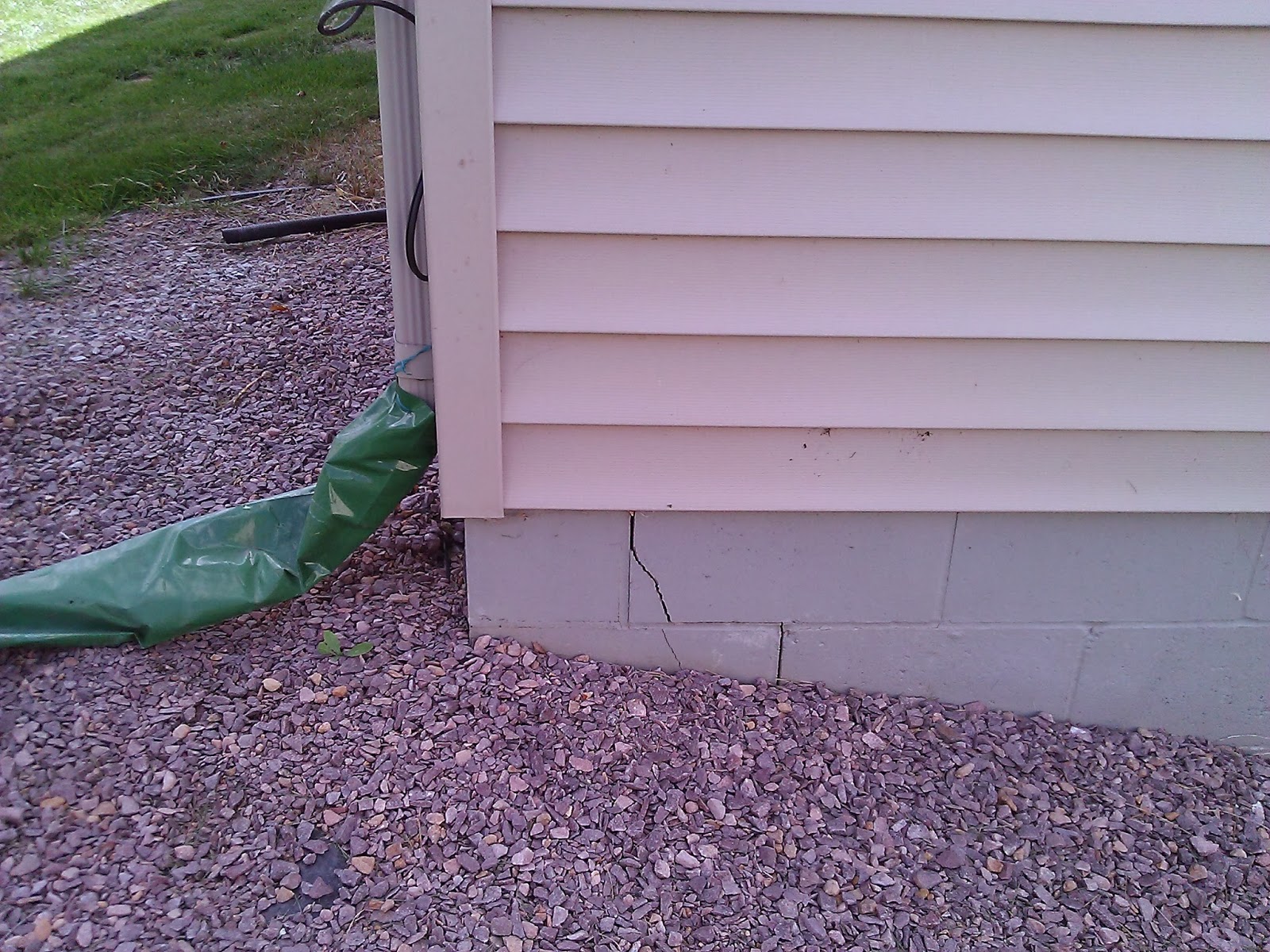
This block wall foundation is a great example of several mistakes done by the owner hoping to keep water from entering his foundation and one that was a headache for the homeowner last year during the spring thaw. 

The first mistake is having the downspout end just a few inches from the ground where it is more susceptible to freezing and clogging up.  We always recommend about 18" off the ground to get the proper slope.  In addition we always recommend solid metal or plastic extensions, 10' if possible.  With a good slope and the longer length it will help get that water away from the problem areas.  This extension (the green piece) is also pointed towards the left when it should be pointed at us which would make it easier to hit the slope of the yard heading towards the right.  With this set up the water is getting dumped into the pea gravel (towards the left) but then heading to the right.  Along the route is this nice stair step crack that most likely goes from floor to ceiling in the basement

This basement has a working drain tile system but when there's rain, some of the water does work it's way into the system but the crack we see on the outside is also visible on the inside and taking the path of least resistance, it dumps out above the floor, skipping the drain tile system.


Monday, March 25, 2013

Great article from the Billings Gazette about the bentonite industry.  While this material has hundreds of uses, it's properties make it perfect for exterior foundation waterproofing.


May 21, 2012 12:00 am  • 
GREYBULL, Wyo. — Applications to mine “the clay of 1,000 uses” are pouring into the Bureau of Land Management as companies look to capitalize on the bentonite boom and keep pace with the nation’s rebounding economy.
From mines at Frannie to Bearcreek, companies have ramped up production, racing to extract a commodity that was deposited millions of years ago as volcanic ash and chemically reworked in a shallow, inland seaway.
At M-I Swaco’s mine east of Greybull, BLM geologist Gretchen Hurley holds a lump of bentonite in her hand. With the consistency of Play-Doh, the damp product is easily shaped, rolled and squeezed.
“I think the new applications are a result of companies trying to get ahead of the permitting curve, because it takes a while to permit one of these mines,” Hurley said. “If we can get them approved for a 500-acre mine, that’ll keep them supplied in bentonite for 10 to 30 years.”
Bentonite has the ability to swell to 16 times its original size and absorb 10 times its weight in water. It’s used in cat litter and beauty supplies and as a binding agent in animal feed. It’s also used in foundry work and in drilling, including in the Bakken field of North Dakota.
The clay’s industrial uses tie it directly to the nation’s energy and auto industries. With the economy on the mend, the bentonite industry has followed suit, restoring jobs lost in 2008 while creating an increase in mining applications across the region.
At the American Colloid plant east of Lovell, plant manager Steve Wilkerson said that at height of the recession, around 42 employees lost their jobs. Around 30 of those jobs have been restored and production has increased, surpassing pre-recession figures.
“Before the recession we were running at around 650,000 to 700,000 tons a year,” Wilkerson said. “In 2008, we dropped off to around 280,000 tons. At the present moment, the way things are going right now, we should be back at around 750,000 to 780,000 tons.”
Bentonite means business
The life of a bentonite mine depends on market conditions, and it’s Lyndon Bucher’s job at American Colloid to ensure that a steady flow of clay is available to keep pace with customer demands, including the oil industry, General Motors and Caterpillar.
Bucher, who works in American Colloid’s permitting and reclamation department, said that like all mining operations, clay is subject to booms and busts. Business lately has been up.
“Bentonite is considered an industrial mineral, and so it goes into a number of different products,” Bucher said. “You could say we’re something of a bellwether for the national economy. For the most part, as the economy goes, so goes the bentonite industry.”
Wyoming’s annual bentonite production has risen from 1,400 tons in 1927 to more than 4.5 million tons. Five companies are engaged in 19 active mining plans across several counties in Montana and Wyoming, according to the BLM.
“I’m supposed to maintain at least five years of permitted reserves in every grade of bentonite,” Bucher said. “We’ll do the exploration drilling to locate and grade the product. Once the exploration is done, we know where we need to permit.”
This arid region of the basin, which extends down the western front of the Pryor and Bighorn mountains in Montana and Wyoming, is considered one of the world’s top producers of high-swelling, sodium-type bentonite clay, representing nearly 70 percent of the world's known supply.
According to the Wyoming Mining Association, the industry employs about 605 workers in the Bighorn Basin, including mill operators, mechanics, surveyors, packaging operators and laboratory technicians. For every job provided by the industry, an estimated three additional jobs are created in the community.
In Wyoming, where most of the activity takes place, the industry contributes more than $11.3 million in taxes and royalties. Its annual payroll with benefits comes to roughly $48.3 million, with nearly 70 percent of that paid to employees in the Bighorn Basin.
“Without the bentonite industry, you could fold Big Horn County up and it would go away,” said county Commissioner Keith Grant. “Of our top 10 assessed valuations, four are bentonite companies. The top two are oil and gas, and the railroad is in there, too.”
Remaining reserves
It wasn’t until 1888 that the first commercial shipment of bentonite was made. The clay earned its name from discoveries in Montana’s Fort Benton Formation. It’s been sought after ever since.
Large-scale bentonite mining and processing in this region began near Greybull in the early 1950s. More than 21,000 acres have been mined in the Bighorn Basin to date, according to the BLM.
On the hood of her truck, Hurley lays out a map with the mines designated in red. The bentonite sought by companies lies in a north-south trend along the eastern rim of the basin.
“This whole horizon of gray shale that’s in front of us — we’re looking at a long strike, or a trend, and there are bentonite beds all along that profile,” Hurley said. “It’s a big, huge area.”
Hurley said an inland sea once covered this region while mountain-building volcanoes to the west spewed ash. The ash settled into the sea, where it was chemically worked over time.
Buried by sand, pressurized and compressed, it became the product rolling by the ton into the basin’s plants. There, it’s dried, processed and packaged in powder and granular forms to meet customer needs.
“There are several different beds, and each bed has its own unique properties,” said Jason Schneider, the mining operations manager with American Colloid. “We’re trying to select different beds to meet the demands for the final product.”
Standing at a cross-cut at the Frannie mine on the state line, Schneider notes the striated layers of shale and the bed of bentonite below. Even here in this small pit, no more than an acre in size, the bentonite comes in yellow and blue.
Schneider said each bed of clay is given to a different set of qualities suited for a variety of industrial uses. It’s up to the companies to extract and process the right clay for the job.
“For this location, it’s a lot of drilling mud,” Schneider said. “With the activity in North Dakota, in the Bakken, that increases the demand for drilling mud. Foundry work has been real strong as well — the auto market. Those things are coming back, and when the economy starts to pick up, you see it on this end.”
Estimates vary on how much accessible bentonite remains here in the ground. A 1989 report by the American Institute of Mining Engineers suggests that around 1.1 billion tons have yet to be mined.
A 1980 edition of the U.S. Bureau of Mines, Minerals, Facts and Problems lists bentonite reserves of around 200 million tons. Either way, it’s enough to keep the bentonite industry supplied for years to come.
“If it’s oil and gas drilling, we’ll target a specific clay for that, and if it’s cat litter, we’ll target another clay for that,” Bucher said. “We have many different customers, and we’ll try to meet the market demand by mining in these different areas and getting the right quality of clay into the plant.”

For those looking for exterior bentonite pressure injection for waterproofing you've found the right place.  Exterior waterproofing using bentonite was discussed on the Home Improvement Show with Lindus Construction on WCCO Radio Saturday Morning with the experts agreeing that stopping water on the exterior (with bentonite) is the best way to truly waterproof your foundation.

The example presented was a wet basement floor leaking from the seam the floor and wall make.  In most cases this is a cold joint with no gasketing meaning that it's two pieces of concrete installed at different times.  Once the water pressure outside is high enough it will push water through this area.

Using a waterproofing mix of all-natural bentonite, Great Lakes Waterproofing fills the water-pathways, once the bentonite sets up water cannot pass through it, creating a waterproof barrier.  More water pressure just pushes the bentonite tighter against the foundation.

For new construction we can install a bentonite membrane before the concrete is poured.  We overlap all the seams and cover everything below grade.  Once backfilled this is one of the most durable types of waterproofing known.

Saturday, October 6, 2012

Waterproofing older homes and buildings


Great Lakes Waterproofing is proud to have been selected to waterproof the historic home of President Benjamin Harrison located in beautiful Indianapolis Indiana  Great Lakes Waterproofing does several similar projects using our exterior waterproofing system that consists of injecting bentonite clay, or hydroclay, around the perimeter of the home.  In most cases excavation is not necessary since we use small diameter pipe that's pushed down to the footing (basement floor level).  Keeping the landscaping intact and having little intrusion on the interior is why homowners and business owners chose Great Lakes Waterproofing. While interior drain tile systems have a place, most buildings and homes are better suited for exterior waterproofing, stopping water before it gets inside. 
In older homes there are several reasons an underfloor drain tile system is not considered, such as, disturbing the basement floor might not be an option, or the basement area is finished and putting in an underfloor drain system will cause too much damage.  One of the most common issues is if the walls are poured (solid concrete) or the builder used solid rock, limestone walls are very common in the Midwest.  Drain tile is very ineffective with these mostly solid walls, the water enters the basement above the floor and cannot get into the drain tile system.
 
That brings us back to exterior waterproofing, not only are we sealing off the water pathways but we also help the stone and mortar stay drier, ensuring longer life.


. 

Sunday, March 1, 2009

Drain Tile & Cove Drain in Action

Wow, a picture sure is worth a million words. In this wet basement photo we have a block wall filled with water. It has the typical signs including staining of the wall at the mortar joints, cracks with staining and moisture present. The homeowner has installed both a drain tile system and a cove drain system.

The drain tile system is high-end with a nice control panel for the pump and there's probably a battery back-up for the pump install in another room in case there's a power failure. The white PVC pipe is the sump pump discharge that goes out to the yard.


There's also a cove system installed at floor level. Several holes have been drilled into the cinder block cores at the floor level to relieve any water that fills the concrete blocks. Cracks in the outside wall have allowed water to build up in the blocks and the holes should provide an exit for the water which drains into the channel that leads to a sump pump.


Great Lakes Waterproofing was called in because this area was still getting wet and not a little wet but a lot wet, in fact a hole that someone had drilled into the block had a stream of water pouring out of it. Not only was the hole drilled 33" above the floor level but the blocks were full of water at this level. (a cinder block holds approximately 1.7 gallons of water)

The upper photo is roughly 7.5' wide by 4'+ tall, there's close to 51 gallons of water in this area of block, maybe more looking at the staining on the bottom course of white block. Imagine a typical city house with a footprint of 24' x 24', one wall could have hundreds of gallons of water in the blocks.


In this situation Great Lakes Waterproofing sealed the outside of the basement wall stopping the water before it filled the blocks truly waterproofing the basement

The cove system failed because rocks and debris clogged it up the water was unable to drain into the channel. The drain tile system failed for the same reason, the cracks on the outside wall were large enough to allow rocks and debris to fill up the first course of block, once filled both systems don't have a way drain the water. What options do you have when your water management system fail?

Saturday, August 9, 2008

Landscaping and Waterproofing

While landscaping can help with waterproofing your wet basement several steps need to done to insure water is running away from the foundation and not into the basement. This house had the entire yard landscaped with rocks, plants, mulch and a multi-tiered rock wall.

Above the basement wall is a board called the sill plate. The sill plate is a horizontal wooden board attached to the concrete basement wall and supporting the above ground walls. This board should be at least 6"-8" above the finished grade.

This photo shows new landscaping that's been graded as high as the sill plate. Although you can't see it, the bottom of the sill plate is even with the bottom of the rock siding. The area in the center of the photo also has a small slope towards the home and rock wall.

During a rain storm, water would build up in the center area and enter the house between the sill plate and basement wall. While the house had a drain tile system none of this water was captured and ended up on the floor creating a very wet basement.


Some of the signs that the water is coming in from above ground include stains on the wall as in the case of this window. In this case heavy rains would spill over the window frame into the basement area. Once again a drain tile system would not work with this wet basement.

http://www.tcwaterproof.com/ http://www.greatlakeswaterproofing.com/

Tuesday, June 3, 2008

Great Lakes Waterproofing is a member of the Better Business Bureau

Great Lakes Waterproofing is committed to excellence and we're giving our waterproofing customers the ability to shop with confidence by being a member of the Better Business Bureau.
Members must meet a high level of customer satisfaction to stay in good standing and we're committed to providing the highest level of service for our Midwest customers that demand the best. The Bureau has always been a great source for customers to research contractors and find out if there's any red flags. As our customers already know, Great Lakes Waterproofing is the premier waterproofer for Minnesota, Michigan, Wisconsin, Iowa, Illinois and Indiana.

Friday, April 4, 2008

It's Springtime in the Midwest, Now is the Time to Waterproof

With all the swings in the weather, now is the perfect time to waterproof your basement, parking garage, retaining wall, etc. The Great Lakes Waterproofing Method works from outside preventing water from getting through your walls. With all of the expansion and contraction of materials built up outside your wall, water is being forced at up to 500 pounds per square inch into your basement. Our system injects hydroclay into the soil which fills the voids and small cracks in your walls....once injected it absorbs water and expands like a sponge eventually turning into a permanent, flexible barrier against moisture. Unlike other methods, we use all natural materials as specified by the National Institute Of Science making us one of the very few Green Waterproofing Methods. Used in thousands of installations including tunnels, manholes, dams, ponds, dumps, our method has proven itself time and time again.

Friday, February 8, 2008

Fixing Hollow Basement Floors

One of the benefits of the Great Lakes Waterproofing Process is that it fills in voids that would otherwise fill with water or become home to critters. In addition to waterproofing vertical walls, our process can also be used to fill in voids under your basement floor.
Over time the base beneath your basement floor might slowly "wash" away leaving the floor with a hollow thump when you walk over it. We see (or hear) this quite a bit in older houses. Once the foundation underneath the floor is gone the concrete has more of a tendency to crack without the support.
Using our Hydroclay Injection Process we drill holes through the basement floor and pump underneath the floor filling the voids with our expanding clay. In addition to providing support to the floor it also plugs up passages used by unwanted critters, including rats and mice, that might have taken up refuge. The injection holes are filled with mortar and the process is complete.

Tuesday, September 25, 2007

How The Homeowner Can Help

The first question we get asked is "how can I help?" While the Great Lakes Waterproofing System works in nearly all applications, there are steps that can be taken to help insure that the basement dries up completely. The most common problem is improper drainage away from the structure, make sure gutters are attached properly and the extensions are long enough to clear all obstructions including patios, sidewalks, trees, etc.
For a typical mid-size house 1/2" of rain on the roof will be over 150 gallons of water, some houses only have two downspouts so over 75 gallons of water could be concentrated in one area. This is why it's crucial that the water is channeled away from the structure and not left to saturate into the ground near the foundation. Our experience has shown that even placing plastic on the ground around the house does little to channel the water away if other steps are not taken first.


Another place overlooked is the window wells. The gravel should be at least 4" thick and about 8" below the window. Over time debris builds up in the wells and if not cleaned out will provide water an easy entrance between the window frame and the wall.

Last but not least, observe the concrete and pavers around the house. Over time these will settle (usually sloping towards the house) providing a funnel of water right into the basement. Look for the tell-tale signs of dirt and sand built up on the concrete or pavers. Although expensive, replacing the concrete with a surface that slopes away from the structure might be one of the solutions. Proper surfaces should be slightly above the ground with a slight slope away from any structures.

Saturday, August 11, 2007

Waterproofing With Bentonite


For over 30 years Great Lakes Waterproofing has been providing one of the most exciting waterproofing methods for home and business owners. Using our exclusive technology we inject a waterproofing blend of bentonite clay into the area around the basement floor and walls. In most cases this can be done from outside with nearly no damage to the existing ground cover. Once the Bentonite Hydroclay has saturated the ground, filled in voids and small cracks in the concrete walls, it begins to absorb water and solidify to a consistency similar to peanut butter providing a permanent barrier against water.  If your construction is new or you've exposed the wall we can apply benonite panels and membranes directly to the wall giving you the best waterproofing possible 

While methods such as filling cracks with mortar, applying an epoxy-base paint or a drain-tile type system help with diverting water, they all have one similar yet critical component...They still let the water through the wall before it gets stopped. The damage this causes to the wall continues as long as the water is present. Settling of the wall and mortar damage on block wall will continue requiring on-going maintenance.
Our method of waterproofing has been successful in many different applications, our blog will have case studies on several of these applications and the questions we encounter from time to time.

www.TCWaterproof.com