It's getting close to springtime in Minnesota and with the heavier than usual snowfall that means lot's of moisture. This year will probably be different than last year where the ground was frozen solid and a lot of moisture was entering foundations through cracks that extended above grade level.
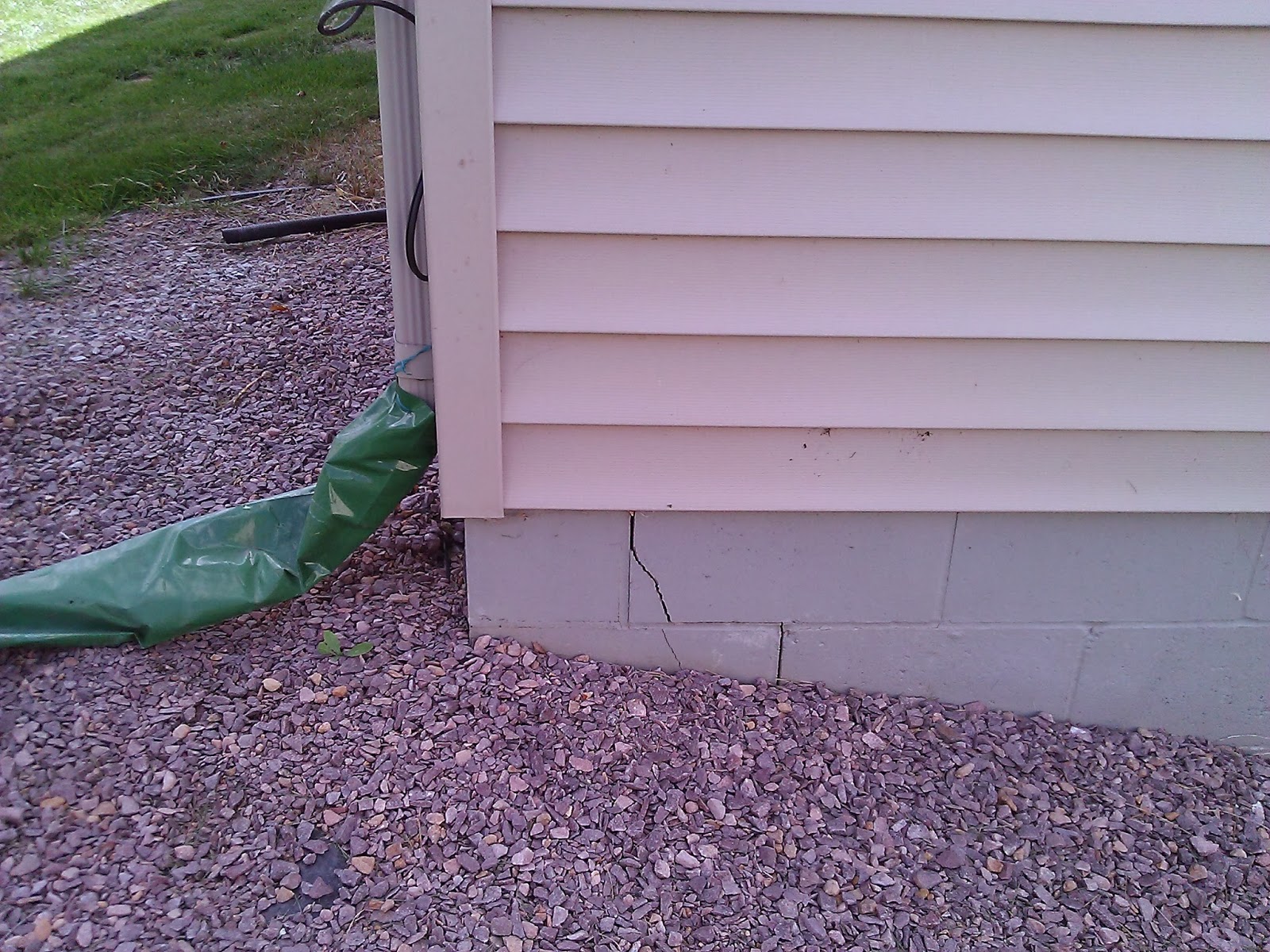
This block wall foundation is a great example of several mistakes done by the owner hoping to keep water from entering his foundation and one that was a headache for the homeowner last year during the spring thaw.
The first mistake is having the downspout end just a few inches from the ground where it is more susceptible to freezing and clogging up. We always recommend about 18" off the ground to get the proper slope. In addition we always recommend solid metal or plastic extensions, 10' if possible. With a good slope and the longer length it will help get that water away from the problem areas. This extension (the green piece) is also pointed towards the left when it should be pointed at us which would make it easier to hit the slope of the yard heading towards the right. With this set up the water is getting dumped into the pea gravel (towards the left) but then heading to the right. Along the route is this nice stair step crack that most likely goes from floor to ceiling in the basement
This basement has a working drain tile system but when there's rain, some of the water does work it's way into the system but the crack we see on the outside is also visible on the inside and taking the path of least resistance, it dumps out above the floor, skipping the drain tile system.
Showing posts with label landscape waterproofing. Show all posts
Thursday, March 6, 2014
Monday, October 8, 2012
Voids Around the Foundation
Sometimes it's hard to explain to a home owner that they might have large air cavities next to their foundation, sometimes even running the length of the wall that might be letting in large amounts of water. Over time the ground has settled and leaves voids that fill with water during a hard rain or even when watering the lawn.
With our Great Lakes Waterproofing's Bentonite (Hydroclay) Injection System the idea is to fill these voids in with Bentoseal Bentogrout. This Bentonite Compound will fill the voids, seek out the water pathways and when properly set up, not let further water invade this space, true waterproofing, stopping water on the outside before it has a chance to enter the home.
It's not often we get a chance to show a photo of these voids but these clearly show that once the driveway was cut away it exposed these air cavities. These cavities can hold hundreds of gallons of water and once the water finds an opening it will drain onto your floor, this can last days after the rain stops.
The water can enter the blocks or poured wall at any point, Some waterproofers might recommend digging around the foundation, maybe two or three feet and laying a rubber membrane bolted to the foundation, this is why membranes that only go a few feet down are useless, the point of entry might be further down
the wall, we've poked through membranes and found voids further down. Yes, we've done work on homes with rubber membranes. For exterior waterproofing there's only one company that pulls together over 34 years of business experience.
With our Great Lakes Waterproofing's Bentonite (Hydroclay) Injection System the idea is to fill these voids in with Bentoseal Bentogrout. This Bentonite Compound will fill the voids, seek out the water pathways and when properly set up, not let further water invade this space, true waterproofing, stopping water on the outside before it has a chance to enter the home.It's not often we get a chance to show a photo of these voids but these clearly show that once the driveway was cut away it exposed these air cavities. These cavities can hold hundreds of gallons of water and once the water finds an opening it will drain onto your floor, this can last days after the rain stops.
The water can enter the blocks or poured wall at any point, Some waterproofers might recommend digging around the foundation, maybe two or three feet and laying a rubber membrane bolted to the foundation, this is why membranes that only go a few feet down are useless, the point of entry might be further down
the wall, we've poked through membranes and found voids further down. Yes, we've done work on homes with rubber membranes. For exterior waterproofing there's only one company that pulls together over 34 years of business experience.
Subscribe to:
Posts (Atom)